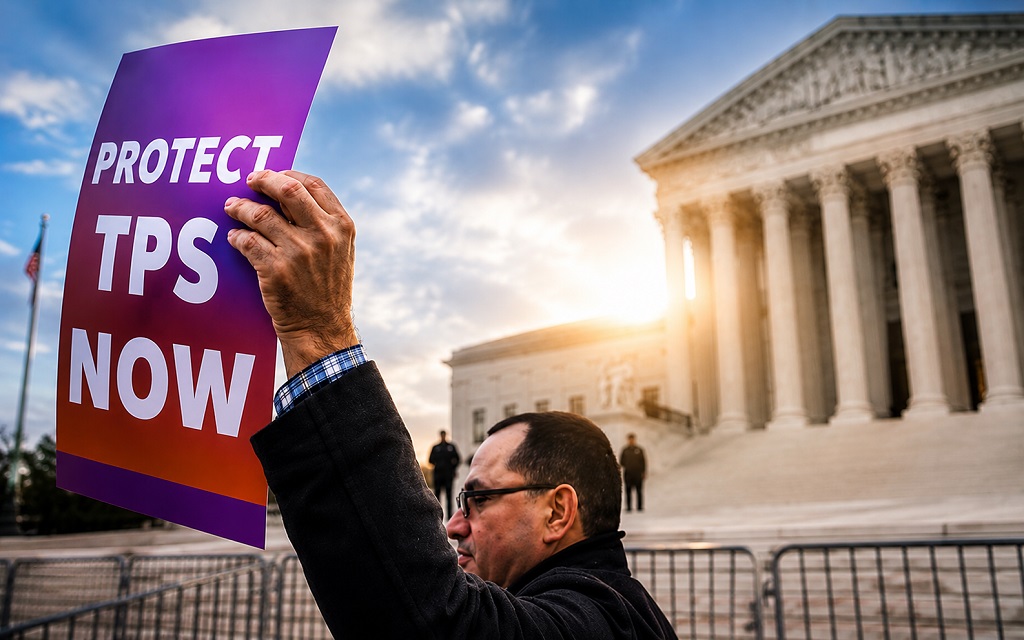
The Trump administration’s Yemen TPS lawsuit did not stop the termination. TPS for Yemen ended on July 20, 2026. A federal judge blocked the termination on May 1, but the Supreme Court’s June 25 decision in Mullin v. Doe took away the legal basis for that block. Plaintiffs have added new claims and asked the court to restore protection. That request awaited a decision as of the last public update from their lawyers on July 28, 2026.
What is the Trump administration Yemen TPS lawsuit?
The lawsuit is Abdo Doe v. Mullin, a class action in the U.S. District Court for the Southern District of New York, case number 1:26-cv-02280. Seven Yemeni TPS holders filed it on March 19, 2026, to stop the Department of Homeland Security (DHS) from ending Temporary Protected Status for Yemen.
The Center for Constitutional Rights (CCR) and the Asian American Legal Defense and Education Fund (AALDEF) represent the plaintiffs. The court consolidated the case with a second challenge, Noor Doe v. Noem. Together, the two cases brought 16 named plaintiffs before the court. Fourteen held TPS. Two had applied for the first time.
Coverage often describes the case as a fight over Yemeni refugees’ deportation protections. Most plaintiffs are not refugees in the legal sense. They hold TPS, which shields them from removal and lets them work, but is not refugee status. The distinction matters once TPS ends, because refugee status carries a path to a green card and TPS does not.
The plaintiffs made two kinds of claims:
- Administrative Procedure Act (APA) claims. DHS skipped the country conditions assessment and agency consultation that the TPS statute requires. DHS also gave only 60 days’ notice, a sharp break from past practice.
- A Fifth Amendment equal protection claim. The termination was motivated by race and national origin.
The class is small compared to Haiti or Syria. Figures cited in the litigation put it at about 2,810 current Yemeni TPS holders plus roughly 425 people with applications on file. News reports round that to “nearly 3,000.” You’ll see one site claim 1,100. That figure is wrong.
Keep the two case names straight when you read coverage. The government’s Supreme Court case is Mullin v. Doe. The Yemen case is Abdo Doe v. Mullin. They share a defendant and a surname. They are different cases.
Why did DHS end TPS for Yemen?
The Temporary Protected Status (TPS) termination for Yemen rests on a “national interest” finding, not on improved conditions. DHS said Yemen no longer meets the statutory requirements and that keeping Yemeni beneficiaries in the country is “contrary to our national interest.” Then-Secretary Kristi Noem made that determination and announced it on February 13, 2026.
The 2015 designation followed the outbreak of the Yemen civil war. Here is the paper trail from that point forward:
| Date | Event |
|---|---|
| September 3, 2015 | Yemen civil war triggers the 2015 designation |
| 2015–2024 | Designation renewed six times |
| February 13, 2026 | DHS announces termination |
| March 3, 2026 | Notice published at 91 Fed. Reg. 10402 |
| May 4, 2026 | Scheduled effective date, 60 days later |
One detail sets Yemen apart from every prior TPS termination. DHS’s own country conditions assessment conceded that the dangers still exist. DHS ended the designation anyway on “national interest” grounds. Judge Dale Ho later noted that no Secretary had used that rationale to end TPS in the program’s 35-year history.
Two other policies hit the same population at the same time. Yemen was one of 12 countries on the June 2025 travel ban. The administration also suspended asylum processing and benefit adjudications for Yemeni nationals, per CCR’s case page. So a Yemeni TPS holder who lost status in July had fewer fallback options than a Haitian or Syrian TPS holder in the same position.
What did the judge rule on May 1, 2026?
Judge Dale Ho postponed the termination three days before it took effect. He found DHS acted “in clear disregard” of the procedure Congress set for ending TPS. His 36-page opinion came after oral argument on April 16.
The opinion rested on three findings:
- DHS did not conduct a proper country conditions assessment for Yemen.
- DHS did not consult the appropriate federal agencies, as the statute requires.
- DHS failed to justify the change from six straight renewals to a 60-day termination.
Judge Ho also pointed out that every district court that heard the same procedural argument for other countries had reached the same result, as Al Jazeera reported at the time. He was the latest in a line, not an outlier.
What “postponement” meant in practice. The order was not a permanent injunction. It used a provision of the APA that lets a court delay the effective date of an agency action until the case ends. The practical effect was the same for TPS holders. Status continued. Work authorization continued. CCR and AALDEF issued guidance to employers and state DMVs on May 6, 2026, that confirmed Yemeni TPS holders kept lawful status and could still renew driver’s licenses. The order had no fixed end date.
You can read the full opinion on the Southern District of New York’s website.
How did the Supreme Court’s Mullin v. Doe decision affect the Yemen case?
The Supreme Court held on June 25, 2026, that federal courts cannot review nonconstitutional challenges to a TPS termination. That single decision removed the legal foundation of Judge Ho’s May 1 order.
Mullin v. Doe was not about Yemen. The case combined the government’s appeals in the Haiti case (more than 350,000 people) and the Syria case (about 6,100 people). The Court argued it on April 29 and decided it 6-3, in an opinion by Justice Alito. The Court also said the Haiti plaintiffs’ equal protection claim was unlikely to succeed.
Here is the chain that turned a Yemen win into a Yemen loss:
- Judge Ho’s May 1 order rested on APA claims about procedure.
- Mullin v. Doe held that the TPS statute bars courts from hearing APA claims of that kind.
- The order therefore lost its legal basis, even though the Supreme Court never mentioned Yemen.
The Court left constitutional claims open. But it signaled that race-based claims face a steep climb. That is why the Yemen plaintiffs pivoted to new theories in July.
Both the full opinion and the Congressional Research Service’s Legal Sidebar on the decision are worth your time if you handle TPS matters. CRS concluded that the decision appears to make most DHS decisions on TPS designation, extension, and termination unreviewable.
What happened on July 20, 2026?
Judge Ho ruled on July 20 that his May 1 order would no longer block the Temporary Protected Status (TPS) termination. TPS for Yemen ended that day.
The next nine days moved fast:
- July 20: Plaintiffs filed an emergency request for a temporary order based on two new legal claims. They filed within hours of the judge’s decision.
- July 24: Judge Ho denied the emergency request. The termination stayed in effect.
- Late July: Plaintiffs amended their complaint and filed a renewed motion to postpone the termination for the rest of the case.
- July 29: USCIS published a notice through its SAVE program that Employment Authorization Documents (EADs) with category codes A12 or C19 issued to Yemen TPS beneficiaries are no longer valid.
Yemen was the first TPS country to fall after Mullin v. Doe. Others followed within weeks:
| Country | Court lifted its block |
|---|---|
| Yemen | July 20, 2026 |
| Syria | July 27, 2026 |
| Burma | August 7, 2026 |
| South Sudan | August 7, 2026 |
| Somalia | August 14, 2026 |
| Ethiopia | August 18, 2026 |
One contrast is worth noting. DHS automatically extended TPS for Lebanon by six months on May 29, 2026, because Secretary Markwayne Mullin did not complete his review in time. The new Lebanon expiration is November 27, 2026. The statute’s automatic-extension mechanism still works. It just did not help Yemen.
What is the current status of the Trump administration Yemen TPS lawsuit?
The Trump administration Yemen TPS lawsuit remains active, but TPS itself is terminated as of September 2, 2026. The plaintiffs’ renewed motion to restore protection awaited a decision as of July 28, 2026, the most recent public update from AALDEF.
Three things remain alive in the case:
- The amended complaint with new legal claims, filed after Mullin v. Doe.
- The renewed postponement motion, which asks the court to restore TPS and work authorization for the rest of the case.
- The government’s appeal to the Second Circuit, which challenges the original May 1 order.
Be realistic about the path. The APA claims that won in May are gone. The equal protection claim faces the Supreme Court’s stated skepticism. The new claims have not yet been tested. A fresh order from Judge Ho would restore protection. No other court action will, short of a change from DHS or Congress.
We will update this section when the court rules. Check the “Last updated” date at the top of the page.
What should Yemeni TPS holders do now?
Talk to an immigration attorney now, and do not rely on a TPS-based EAD for work, travel, or benefits. Your Employment Authorization Document (EAD) with category A12 or C19 stopped being valid on July 20, 2026, even if the expiration date printed on it is later.
Here is what changed and what to ask a lawyer about:
Work authorization validity
Your TPS-based EAD is invalid. Employers who learn of this must reverify your work eligibility. You can present any other valid List A or List C document you hold, such as a separate EAD tied to an application that is still in process.
Unlawful presence
People with no other status generally start to accrue unlawful presence once TPS ends. The rules are strict. More than 180 days can trigger a three-year bar on reentry. More than one year can trigger a ten-year bar. Ask a lawyer to confirm how these rules apply to you and whether any application on file pauses the clock.
Other relief
Ask about family-based petitions, asylum or adjustment applications already on file, and any other form of status you might qualify for. Note that the government has suspended asylum processing for Yemeni nationals. A lawyer can tell you whether a filed application still protects you from removal.
A concrete example
Say you came from Sana’a in 2016, hold TPS, and manage a bodega in the Bronx. Your EAD says it expires in 2027. It does not matter. As of July 20, that card no longer authorizes you to work. Your employer may need you to reverify, and your risk of removal increases the same day. Your first call is to a lawyer, not to USCIS.
AALDEF maintains a Yemen TPS Resource Hub with handouts in English and Arabic. Read them before your consultation. You will ask better questions.
Need to know your options after the Yemen TPS termination? Book a consultation with an immigration attorney. Bring your EAD, any receipt notices, and your entry date.
What does the Yemen TPS termination mean for employers?
Work authorization validity for Yemen TPS-based EADs ended on July 20, 2026, so employers must reverify any employee who relied on one.
Here is how to handle it without a discrimination problem:
- Identify affected employees through your I-9 records, not by national origin. Look for EADs with category A12 or C19 tied to Yemen. Do not question every Yemeni employee.
- Give the employee a chance to present other documents. Any valid List A or List C document works. You cannot demand a specific one.
- Complete reverification on the current I-9 supplement. Record the new document and date.
- Do not terminate an employee on suspicion alone. Act on the I-9, not on assumptions.
A concrete example. Say you run a small software studio in Dearborn, Michigan, and one of your developers holds Yemen TPS. She also has a green card application on file through her U.S. citizen spouse. Her TPS EAD is invalid. But she may hold a separate C09 EAD from the adjustment application. That card still authorizes her to work. Reverify with that one and move on. Do not let her go over a card she does not need.
Fragomen and Morgan Lewis have published detailed employer guides on post-Mullin TPS compliance. Read one of them if you have more than a handful of affected staff. USCIS’s I-9 Central page is the official source for reverification rules.
Can Congress restore TPS for Yemen?
Yes. After Mullin v. Doe, Congress is the clearest path left, and members have already pressed DHS on Yemen.
Three facts support that answer:
- CRS flagged the issue. Its Legal Sidebar lists options for Congress, such as an amendment to the judicial-review bar or a statute that protects specific groups.
- Senators wrote to DHS before the termination. Senators Gary Peters and Elissa Slotkin sent a letter to Secretary Noem on February 27, 2026, that urged her to extend and redesignate Yemen. They cited the large Yemeni community in Michigan.
- The House has acted on TPS before. The House voted in April 2026 to extend TPS for Haitians. The bill did not become law, but it showed the mechanism exists.
Temper your expectations. Legislative action on immigration is slow and rarely country-specific. But the courts have narrowed themselves out of most of this fight. That leaves Congress and DHS.
FAQs
Is Yemen TPS still active in 2026?
No. TPS for Yemen ended on July 20, 2026, after Judge Dale Ho lifted his May 1 order. It will only resume if the court issues a new order or DHS reverses course.
Who are the plaintiffs in Abdo Doe v. Mullin?
Seven Yemeni TPS holders who filed under pseudonyms represent a class of all Yemeni TPS recipients and applicants. CCR and AALDEF are their lawyers. The case was consolidated with Noor Doe v. Noem, which added nine more plaintiffs.
Why did the Trump administration Yemen TPS lawsuit lose after the judge ruled for the plaintiffs?
The May 1 order rested on APA procedural claims. The Supreme Court held in Mullin v. Doe on June 25, 2026, that courts cannot hear those claims. The order lost its legal basis, and Judge Ho lifted it on July 20.
Can Yemeni TPS holders still work in the U.S.?
Not on a TPS-based EAD. Work authorization validity for A12 and C19 cards tied to Yemen ended on July 20, 2026. A person with a separate work permit from another application may still work on that permit.
What were the continuous residence requirements for Yemen TPS?
Applicants had to show continuous residence in the U.S. since the date set in the most recent Yemen redesignation notice (January 4, 2017) and continuous physical presence since the effective date of that notice. People who arrived after that date could not qualify, even before the termination.
Did the Supreme Court rule on Yemen TPS directly?
No. Mullin v. Doe addressed Haiti and Syria. Its decision on judicial review applied to Yemen’s case anyway, because the Yemen plaintiffs relied on the same kind of claims.
How many Yemeni nationals held TPS?
About 2,810 people held TPS, and roughly 425 more had applications on file, per figures cited in the litigation.
What is the difference between the Yemen case and Mullin v. Doe?
Mullin v. Doe is the Supreme Court case about Haiti and Syria. Abdo Doe v. Mullin is the district court case about Yemen. The Supreme Court decision controlled the outcome of the Yemen case without ever naming it.
Can the Yemen TPS termination be appealed?
The plaintiffs can appeal a final loss to the Second Circuit. But Mullin v. Doe limits what any court can review. Only the constitutional claims and the new claims added in July remain open.
Disclaimer: This article is general information, not legal advice. Talk to an immigration attorney about your own situation.

Musarat Bano is a content writer for LegalSever.com who covers lawsuits, legal news, and general legal topics. Her work focuses on research-based, informational content developed from publicly available sources and is intended to support public awareness. She does not provide legal advice or professional legal services.